
Explore interior trends, AI design insights, styling guides and real transformations
Mastering the European formal table setting: etiquette, arrangement and refined decor
Introduction
Hosting a formal dinner at home is less about showcasing extravagant recipes and more about orchestrating space, seating and sequence. A well set table speaks the language of hospitality before a single course is eaten. For design‑savvy European homes, a formal dining event is as much about interiors as it is about etiquette: how the room is laid out, the textures of linen, the sheaf of glassware that glistens at the edge of the table, and the quiet rhythm of service. This guide distils traditional table manners into practical design choices that elevate conversations, comfort and style without turning your dining room into a gallery of ceremony.
Space planning for a formal table across Europe
Formal dining requires more space than everyday meals. The plan should ensure the table can accommodate the full set of courses, serving ware and decorative elements while allowing free movement for guests and servers. In European homes, the dining area often doubles as a semi‑public space, so acoustic and lighting considerations matter as much as the surface area. Before laying the linen, take precise measurements of the table length and width, then consider any extension leaves or modular components that might be deployed for larger gatherings. A practical rule is to allocate enough room not only for place settings but also for service movement and for guests to cross the room without bumping chairs.
- Determine the maximum seating capacity you would use for a festive occasion, and plan accordingly rather than relying on everyday dining layouts.
- If space permits, utilise an extendable dining table or combine a dedicated sideboard or serving table nearby to hold extra plates, glassware, flatware and napkins.
- Ensure comfortable leg and knee space for each guest, with a clear gap of about 60 cm between chairs and at least 80–100 cm of usable table length per person for a formal setting.
Seating and host positions
Seating arrangement is a central element of formal dining. In rectangular rooms with a long table, the hosts traditionally sit at the ends. The principal guest, often the guest of honour, occupies the seat to the right of the hostess, while the hostess sits to the right of the host. This convention helps frame the conversation and signals hospitality without crowding the room with too many competing personalities.
For a round dining table, the arrangement differs. The hosts sit opposite one another, and the most honoured seat is typically the one facing the entrance, enabling the host to greet guests as they arrive and to maintain a sense of welcome throughout the meal. If the room allows, position the seating so that guests can see each other across the table, fostering inclusive conversation rather than isolated dialogue.
Alternating seating and courtesy rules
European etiquette often emphasises balanced interaction. A common approach is to alternate guests by gender or by conversation partner, avoiding placing couples directly side by side. This fosters broader engagement and prevents conversations from becoming insular. A traditional reminder is the right‑hand rule in which the person on the host’s right is given special courtesy in terms of conversation and attention, in practice, however, contemporary dining spaces prioritise comfort and ease of communication, adapting these guidelines to the social dynamics of the table.
When planning seating, consider the needs of guests who may require extra space, such as elderly relatives or guests with mobility considerations. The aim is to create a layout that supports easy access to courses and service points while maintaining a lively, inclusive atmosphere.
Table linens and underlays
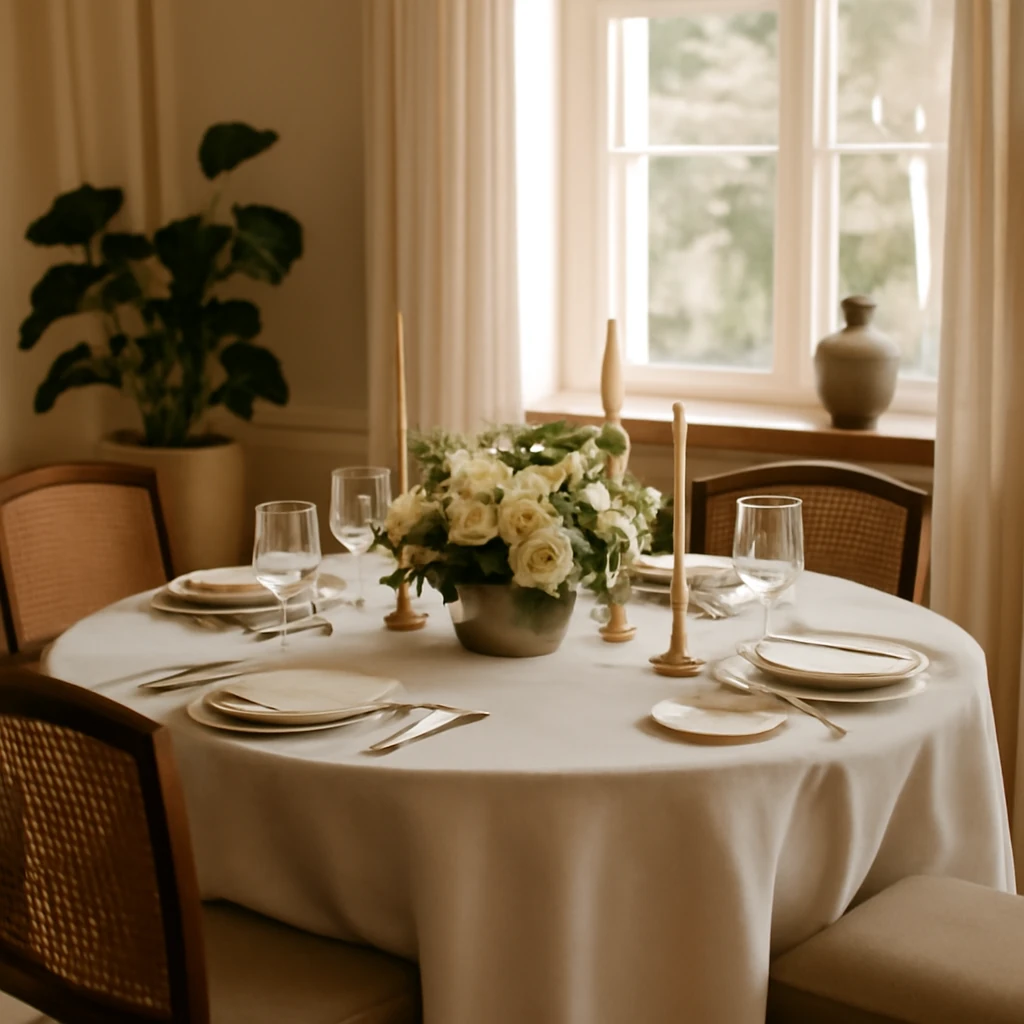
A white or ivory linen tablecloth immediately signals formality and generosity with textiles. The fabric should be substantial enough to lie flat and dampen the sound of cutlery meeting plates, contributing to a refined ambience. An underlay or placemats can protect the table surface and help define each place setting. The length of the tablecloth should extend beyond the table edges by at least 20 cm on all sides, a generous drape enhances the visual line without catching on chair legs or utensils.
When selecting textiles, consider the room’s palette and the table’s architectural features. A crisp white linen is timeless, but soft neutral tones can also work beautifully in contemporary interiors, provided the lighting is flattering and the textiles are of a high quality. The aim is cohesion between the table, the room and the dining experience rather than a collage of disparate textures.
Napkins and their materials
Natural fabric napkins add a layer of sophistication that synthetics cannot easily replicate. Linen and Egyptian cotton are ideal choices for their texture, drape and feel. Polyester or blended synthetics tend to slip and slide, which can be distracting as guests attempt to unfold or place them on their laps. The recommended napkin size for a full meal is around 50 cm, though some hosts opt for a 60 cm or larger square in keeping with a generous, formal look. A neatly folded napkin on the lap is a sign of attentive presentation and helps frame each guest’s personal space.
- Napkin placement options include left of the plate or placed to the right within the right‑hand cluster of utensils. Traditional French practice often places the napkin to the left, while English and other European traditions may allow more flexibility depending on room layout and guest preferences.
- When not in use, the napkin can rest on the chair back during brief pauses in the meal, or be laid gently on the lap at the start of the first course.
Plates and dish arrangement
Place settings should provide even spacing between courses and plates. A charger or underplate can serve as a stable base for the main plate. For formal service, an additional service plate may be set above the main plate for starters and other courses as they are introduced. A bread plate sits in the top left corner, while a small plate or saucer may accompany soups or hot dishes as required by the course sequence. Remember that state and country traditions can influence exact arrangements, so adapt the placement to your guests’ expectations and room aesthetics while maintaining core European etiquette principles.
Cutlery and placement
Cutlery follows a straightforward rule: use utensils from the outermost to the innermost as courses are served. The rule helps ensure a smooth dining rhythm and reduces the risk of accidental misplacements as courses arrive.
- Spoons and knives are positioned to the right of the plate, forks go to the left. An exception exists for certain shellfish or delicacies that may be served with a specific utensil on the right side of the plate.
- When multiple courses are served, additional forks and knives are brought in from the outer edge toward the plate as the meal progresses.
- Dessert utensils are commonly placed above the main plate area. The conventional alignment places the dessert fork to the left of the dessert spoon, with the handles oriented toward the right when space allows. If space is tight, you may place the dessert utensils horizontally above the plate with the fork on the left and the spoon on the right, following the course sequence.
Glassware and beverages
Glassware is arranged at the upper right of the place setting. The water glass sits closest to the plate, followed by wine glasses arranged in order of anticipated use for the courses ahead. If a dessert wine or cordial is planned, place the corresponding glass after the wine course so the guest’s grip remains uncrowded and comfortable. When a decanter or carafe is used, position it within easy reach of the server or host to facilitate service without interrupting conversation.
Decor and ambience
Decor should enhance rather than obstruct conversation. The aim is a table that feels inviting and calm, allowing guests to engage freely. Keep decorative elements modest in height to preserve sightlines and voices. A low floral arrangement, a handful of seasonal greens, or a graceful collection of candles can create atmosphere without dominating the space. A practical guideline is to keep decorations beneath 25 cm in height so that guests can exchange glances and speak without leaning or craning.
Decorative schemes and materials
Interior designers often treat the dining table as a stage for a cohesive narrative. A restrained palette of whites, creams and warm naturals can be punctuated with subtle accents in metal, wood or glass to reflect the room’s architectural details. For a Nordic or minimalist European look, combine clean lines and tactile textures such as linen, wool and stoneware. For a more classic European dining room, consider warm wood finishes, crisp white dinnerware, and crystal glassware that catches the candlelight. The key is harmony between textiles, crockery, glassware and décor, with each element reinforcing a sense of calm and deliberation rather than spectacle.
Serving sequence and practical workflows
The traditional progression for a formal European dinner starts with cold hors d’oeuvres or light starters, followed by soups, the main course, and finally dessert. Coffee or tea is typically served after dessert, and it is customary to refresh the table setting for this closing moment if the hosts wish to maintain a pristine appearance or to reintroduce a lighter aesthetic for the final conversation and closing drinks.
To streamline service and maintain an uncluttered table, consider a nearby sideboard or console that can act as a staging area for utensils, extra napkins, bread plates, and unopened beverages. A discreet service station minimises interruptions while guests enjoy their conversation. In a modern European home, where kitchens are often open to dining spaces, a well‑placed service table can act as a bridge between room design and dining etiquette, aligning practicality with refinement.
A practical checklist for hosts
- Assess the room layout and table geometry. Confirm seating capacity and ensure there is space for guests to move and converse without obstruction.
- Choose an appropriate table linen and underlay. Ensure the length overhang is at least 20 cm and that the fabric complements the room palette.
- Decide on napkin material and size. Prefer natural fabrics such as linen or Egyptian cotton, with a practical size around 50 cm to 60 cm.
- Arrange plates, underplates and bread plate in place before guests arrive. Keep the distance between place settings clean and consistent.
- Position cutlery from the outer edge inward, with forks on the left and spoons/knives on the right. Place dessert utensils above the plate if space allows.
- Set glasses to the upper right, in the order of use, with water glass closest to the plate.
- Decide on a decor scheme under 25 cm in height. Use a restrained arrangement to keep faces visible and conversations flowing.
- Prepare a sideboard or console near the dining area for service support and easy replenishment of items between courses.
- Communicate hosting intentions clearly with guests, balancing formal etiquette with warmth and approachability to ensure everyone feels comfortable.
Country‑by‑country nuances in Europe
European dining etiquette reflects diverse traditions shaped by culture and history. While core principles - courtesy, conversation, and a tidy presentation - remain constant, details may vary by country. For example, in some regions the napkin is traditionally placed to the left of the plate, while in others it may be placed more flexibly depending on the room layout and personal preference. The bread plate and the drinks service are sometimes treated with regionally distinct customs, such as the placement of the bread on the left and drinks on the right or a preference for keeping certain utensils in specific positions throughout the meal. When hosting across European guests, it is sensible to adopt a flexible approach: establish a clear framework for the formal aspects - but allow natural conversation to guide any realignment that makes guests feel comfortable and welcomed.
Practical design notes for different room configurations
Not all European homes feature a dedicated dining room. In open‑plan living spaces or multi‑use rooms, the dining area is often defined by lighting, rug scale, seating arrangement and the alignment of a credenza or sideboard to create a boundary between spaces. In smaller rooms, a compact extendable table paired with a low, unobtrusive centrepiece can create a sense of ceremony without overwhelming the space. In larger rooms, consider a long, elegant table with a restrained focal point at the far end to maintain proportion. Good lighting is essential, layered lighting - ambient, task and decorative - helps to sculpt the mood across the course of the meal while ensuring that the participants can read menus and identify the different courses without glare.
Expert perspective
To provide a considered, practical view, a recognised etiquette professional specialising in protocol and dress codes offers guidance on modern and traditional settings across Europe. The expert highlights the importance of thoughtful seating and comfortable spacing as the foundation of a successful dinner. They emphasise a restrained yet expressive decorative approach, balancing formality with warmth. A European approach to formal dining recognises that a room’s interior design, lighting, textiles and glassware should support conversation and hospitality, not overshadow it. The goal is a table that feels both ceremonial and intimate, where guests can engage, laugh and linger without feeling weighed down by ceremony.
You may also like these articles
 Living room
Creating a Centre of Calm: European Living Room Design Guide
Master the living room with stylish layouts, lighting and furniture.
Renovation
Five renovation types for European homes: a practical guide
A practical guide to five renovation paths for European homes.
Small Spaces
Small spaces, big style: Essentials for European apartment design
Smart strategies to transform compact European homes into comfortable, stylish spaces.