
Explore interior trends, AI design insights, styling guides and real transformations
Decorative partitions: flexible zoning for European homes
Introduction: Decorative partitions as design instruments
Decorative partitions have moved well beyond simple room dividers. In contemporary European interiors they function as sophisticated design tools, shaping how we experience light, sound and privacy. The right partition can carve out a sleeping corner in a compact city flat, establish a dressing zone within a master suite, or delineate a study nook in an open-plan living area - all without major structural work. For designers and homeowners alike, partitions offer a flexible language for space-planning in diverse contexts, from light-filled apartments in historic centres to new-build flats with fluid layouts.
In practice, the choice of partition is guided by three core considerations: the level of light you wish to preserve, the degree of privacy or acoustic separation required, and whether you need integrated storage or technical services (lighting, power, or shelving). This article unpacks the main types of decorative partitions, their advantages and limitations, and practical ideas for applying them across European homes.
Pros and cons of decorative partitions
- + They delineate distinct functional zones without demanding major renovations or structural changes.
- + They can provide anchor points for equipment, shelving and decorative display, turning a partition into storage or a feature.
- + They inject character and texture, helping to personalise spaces and create visual interest.
- + In many cases, partitions cost less than building a new wall while offering greater flexibility for future reconfiguration.
- − Not all partitions deliver full acoustic privacy, some are primarily visual or light-filtering.
- − Higher-end solutions can be expensive, depending on materials, fabrication, and installation complexity.
- − Some designs require careful maintenance, especially those using natural materials or metal frames in humid environments.
In European projects, well-considered partitions work best when they respond to the room's geometry, the position of windows, and the need for seamless daylight throughout the day.
Variants of decorative partitions
Decorative inter-room partitions are produced from a range of materials and techniques. The right choice depends on the intended effect, climate, and the room's style. Below are the most popular options, along with practical notes for implementation in European interiors.
- Glass partitions
Glass partitions
Glass partitions are typically framed in metal profiles that hold tempered glass or laminated safety glass. The key advantage is transparency: they preserve daylight access and create a sense of continuity, which is particularly valuable in rooms with limited windows or in open-plan layouts. Glass partitions are versatile in European homes because they visually expand spaces while offering privacy when needed.
Glass can be left transparent for maximum openness, or treated with frosted, etched, or patterned finishes to soften visibility. Doors - whether fixed, sliding, or hinged - can be incorporated within the same frame. Panels are commonly produced in widths from around 60 cm to 120 cm, with thicknesses typically 6–12 mm for tempered glass or laminated stacks for safety and acoustic considerations.
Glass partitions work especially well in living areas with one primary window, enabling light to reach deeper into the floor plan while defining sleeping or work zones.
- In practice, glass partitions are often paired with a blackout curtain or a roller blind for light control and privacy when required.
- Curtain partitions
Perforated textiles and heavy drapery
Curtain partitions offer an affordable, reversible, and quick way to divide space. Heavier fabrics with blackout properties can completely shield a sleeping zone, while lighter fabrics allow soft diffusion of light and sound. The track system at the ceiling enables easy reconfiguration as needs change, and curtains can be easily updated to refresh the room's mood.
From a design perspective, curtains provide a tactile, textile element that can warm a cool, industrial space or inject colour and texture into a refined, minimalist scheme. Acoustic performance is variable, so they’re often used in combination with other partition types to achieve the desired privacy without sacrificing daylight.
Curtains are practical for flexible living - ideal for temporary screens in guest rooms or home offices within the open-plan living area.
- In contemporary European interiors, curtains frequently accompany glass or wood partitions to balance transparency with privacy.
- Slatted partitions
Slatted partitions
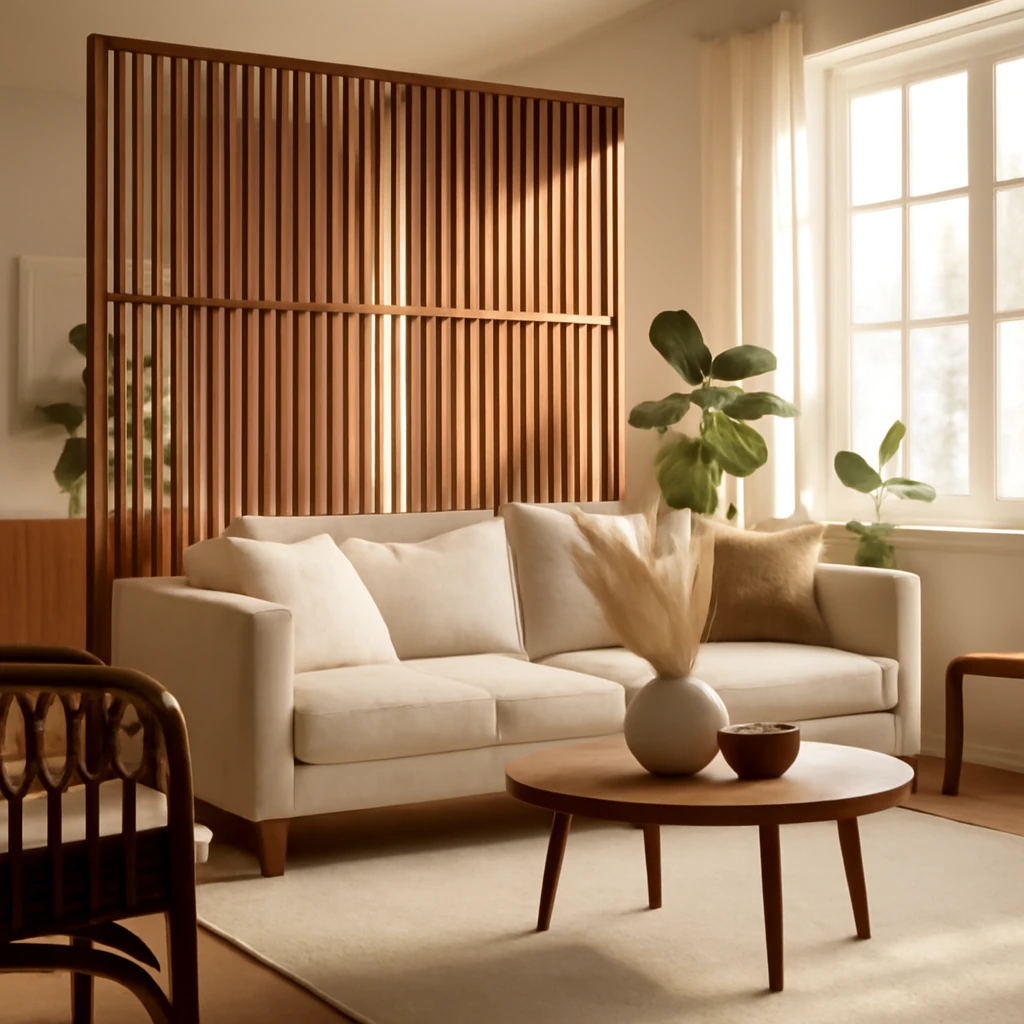
Slatted screens - made from metal, wood, or medium-density fibreboard (MDF) - offer a sculptural, light-filtering solution. Slats can be configured in various spacings to control glare while preserving a coherent sense of space. They are particularly effective in rooms where you want to demarcate areas without creating a heavy, boxed feel.
Wood and metal slats demand attention to humidity and maintenance. Wood may require protective finishes to cope with environmental conditions, while metal may be finished to resist fingerprints or patina. Slatted partitions are frequently extended across a portion of the ceiling or used to carry integrated lighting, turning a simple divider into a functional architectural element.
When used thoughtfully, slatted partitions can continue a wall line, tying together adjacent zones and extending the room’s architecture.
- They commonly appear in living spaces where daylight and airflow are important cues in the design strategy.
- Glass blocks
Glass blocks
Glossy or textured glass blocks have enjoyed a revival in modern European interiors. These bricks create a tactile, light-transmitting screen that physically separates spaces while preserving daylight and a visual sense of openness. They are robust, easy to maintain and can be arranged in various patterns to form decorative configurations.
Cost is a practical consideration: glass blocks tend to be more expensive per square metre than common drywall or curtain options, but they deliver a distinctive architectural texture and acoustic performance that is superior to sheer glass or fabric screens in many layouts.
Glass block installations benefit from precise detailing during construction to ensure airtight joints and an even rhythm along the partition line.
- In homes with long, narrow living areas, glass blocks can subtly segment zones while maintaining a bright atmosphere.
- Drywall partitions
Drywall partitions
Gypsum board (drywall) partitions are built during renovation, allowing a seamless integration with electrical outlets, lighting niches, and built-in storage. They create solid walls that can carry additional features such as recessed shelves, TV enclosures, or acoustic panels. While they provide superior privacy and sound control, they require careful structural planning and skilled installation to ensure stability and fire safety compliance.
Drywall partitions can be designed to terminate short of the ceiling to leave a sense of openness or to accommodate concealed fluorescent or LED lighting. They are an excellent choice when you want a truly defined room with the option to render a fully enclosed space later, should the layout evolve.
In European renovations, drywall partitions are commonly used to craft dedicated dressing rooms or media alcoves within master suites.
- For long-term flexibility, designers incorporate removable or reworkable joints so the partition can be adapted as needs change.
- Brick or concrete block partitions
Brick or block partitions
Solid brick or aerated concrete blocks create robust, weighty walls with excellent acoustic insulation. They’re typically built during the early renovation stage and finished to align with the surrounding surfaces. While heavier and less flexible than drywall, brick or block partitions offer lasting separation and can support built-in shelving, seating, or media installations without additional framing.
These partitions are suited to larger spaces or where a distinctly permanent separation is desirable, such as between a living room and a dining area in a European apartment with a flexible floor plan. They also benefit from thermal mass, which can contribute to a comfortable climate in temperate climates.
When planning brick or block partitions, it is essential to coordinate with structural engineers and ensure compatibility with existing services and fire-safety requirements.
Where decorative partitions are most effective
Decorative partitions can be employed in almost any room, but their strength lies in open-plan environments where flexible living patterns are common. The following scenarios illustrate practical applications within European homes, highlighting how different partitions perform in real settings.
In the studio or open-plan living area - define a sleeping zone
In compact studios and one-bedroom apartments, a partition helps to create a private retreat without isolating the space. A glass or glass-block screen paired with a blackout curtain is a popular solution: daylight remains unobstructed, while the sleeping area becomes clearly defined and visually separate when needed. This arrangement is particularly effective in European cities where living sprawl demands compact, multifunctional interiors.
Design tip: align the partition with the room’s line of sight from the main seating area to preserve the sense of space. Include a cohesive colour palette and finish to ensure the screen reads as a deliberate feature rather than a stopgap.
In the hallway or entrance zone - hide the entry area
Long, visible corridors can feel exposed when the foyer or entry is part of the main living space. A combination of slender slatted screens, perforated metal panels, and partial-height glass blocks can conceal the entry vestibule while allowing natural light to pass through. This approach creates a sense of arrival without compromising openness.
Practical note: in European flats with radiating floor plans, the transition between public and private spaces benefits from partitions that can be easily reconfigured should the function of the space change.
In the kitchen–living area - separate the cooking zone
Open-plan kitchens are a staple in modern European homes. A transparent or semi-opaque partition helps to delineate the cooking area from the living zone while maintaining a visual connection. Glass partitions allow light to travel, while a higher closed panel or a brick/brick-like partition provides stronger separation where needed. For those prioritising storage, consider a partition that doubles as a shelving run or a niche for appliances.
Safety and practicality should guide partition choices in kitchens, especially when gas appliances are installed. Ensure that partitions do not obstruct ventilation or service routes, and choose materials resistant to heat and humidity where applicable.
In the bedroom - create a dedicated wardrobe or dressing area
Bedrooms frequently benefit from a partition that carves out a dressing zone or walk-in wardrobe. A drywall screen can be configured to create a separate room within a room, while a lighter, decorative screen can visually separate the space without fully closing it off. When a full enclosure for clothing and storage is desired, a solid partition or brick/block wall offers robust privacy and sophisticated acoustics.
In many European master suites, designers combine drywall or timber framed partitions with built-in wardrobes or shelving to achieve a seamless, high-end look that remains flexible for future changes.
In the master suite - zone the ensuite bathroom with a screen
Open-plan master suites sometimes feature an en-suite bathroom partially separated by a glass screen or a moisture-rated partition. A glass wall with a full-height privacy curtain can maintain a feeling of openness while enabling privacy when required. This strategy preserves the spatial logic of the suite and fosters a sense of luxury and calm.
Key considerations include ensuring the partition is properly sealed against moisture and that lighting is well integrated so the space remains bright and practical.
How to choose the right decorative partition for your space
- Define your priority - what matters most: daylight and openness, privacy, acoustics, or storage? Your answer will steer you toward glass or fabric screens, solid walls, or hybrid solutions.
- Assess the room geometry - consider window positions, doorways, and sightlines. Partitions should enhance the architecture, not obstruct it.
- Consider climate and maintenance - materials such as wood and metal require appropriate finishes in humid or coastal climates. Glass and blocks demand careful installation but are low-maintenance in many cases.
- Plan for services - lighting, electrical outlets, and data ports can be integrated into drywall partitions or shelving-backed screens. Coordinate with electricians and installers from the outset.
- Evaluate acoustics - if noise reduction is a priority, prefer solid walls or laminated glass, or combine partitions with acoustic panels and soft furnishings to soften sound transmission.
- Budget and future-proofing - think about whether you want a permanent solution or something easily reconfigured as needs evolve. Start with a scalable approach, such as modular glass panels or adjustable curtains.
- Finish and colour - align partition finishes with the room’s material palette. A well-chosen finish can unify disparate areas or act as a contrasting design feature.
Practical design philosophies for European homes
Across Europe, homeowners and designers favour partitions that respect daylight, heritage architecture, and climate. A refined approach combines clarity of line with warmth of material. Here are guiding principles that help ensure partitions contribute positively to a space:
- Respect the light - allow daylight to penetrate deep into rooms. Where privacy is essential, use translucent or etched glass rather than solid canvases that block light.
- Preserve sightlines - in narrow rooms or long corridors, align partitions with architectural cues to maintain a coherent flow.
- Balance texture - mix materials (glass, wood, fabric, and metal) to create tactile depth without overwhelming the space.
- Ensure scale - choose proportions that harmonise with ceiling height and floor area. A misjudged partition can visually shrink a room.
- Plan for maintenance - in kitchens and bathrooms, select moisture-resistant finishes and easy-clean surfaces to reduce upkeep.
In conclusion: turning partitions into strategic design decisions
Decorative partitions offer a compelling spectrum of possibilities for European homes seeking flexibility without sacrificing light, air, or aesthetics. The most successful installations are those that respond to the room’s architecture, the occupants’ daily routines, and the region’s environmental conditions. By weighing the trade-offs between light transmission, privacy, acoustics, and storage, you can select a partition system that both sharpens the space’s organisation and elevates its atmosphere. In practice, the best outcomes come from close collaboration between space planners, interior designers, and installers who understand the nuances of local construction standards and climate realities.
As living patterns continue to evolve, decorative partitions will remain a vital instrument in the European interior design toolbox - offering both practical functionality and enduring visual appeal.
You may also like these articles
 Interior Design
Mid-century modern interiors for European homes
Timeless mid-century modern design, tailored for European living
Colour & Materials
Colour in the European Kitchen: six best combinations and a practical table
Six top kitchen colour pairings for European homes, with a compact reference table.
Tips & How-To
How to join kitchen worktops beautifully and correctly
Seamless worktop junctions for European kitchens: practical guidance and techniques.